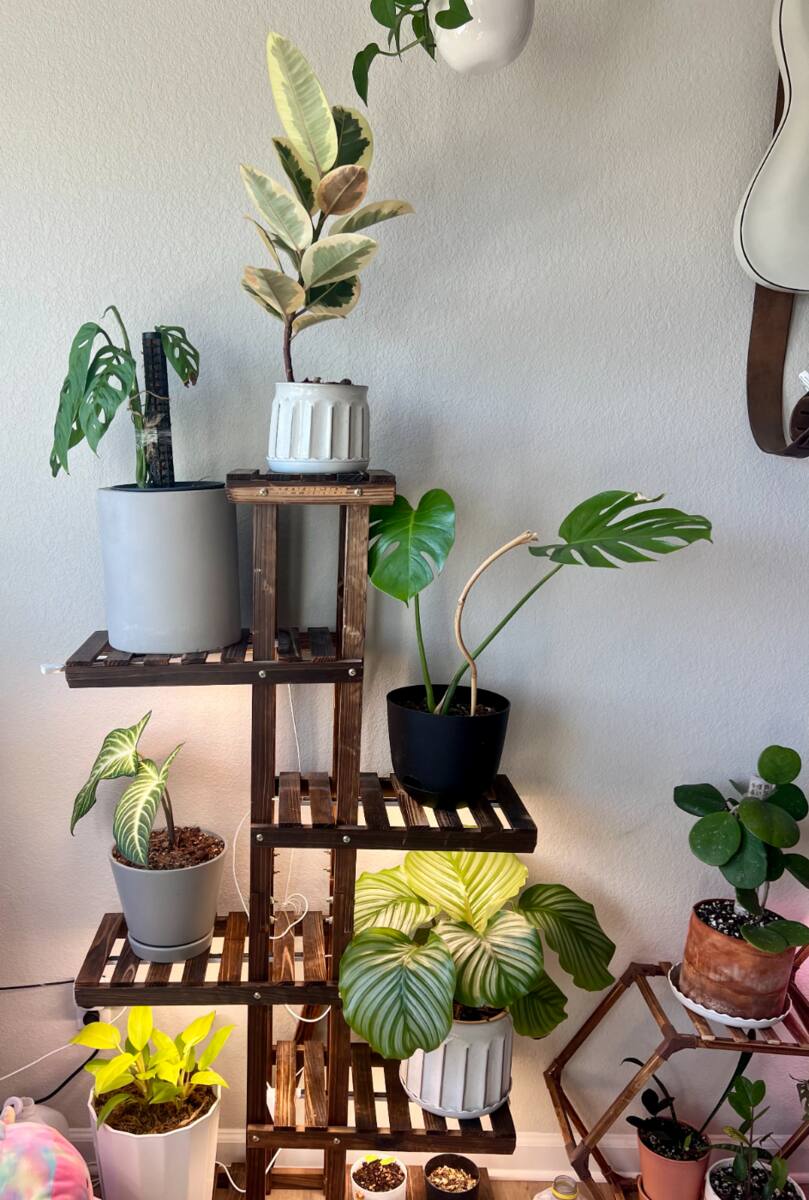
Fiddle leaf figs are the plant I get called about more than any other in Austin. Beautiful, expensive, dramatic — and almost always dying by the time I show up.
It’s usually not the owner’s fault. These plants are sold like decor, with care tags that say things like “water weekly, bright indirect light” and nothing about the actual conditions inside a Central Texas home. Then the leaves start dropping, the brown spots show up, and people assume they’ve killed it.
After 25+ years working with houseplants in Austin, here’s what I’ve learned: fiddle leaf figs aren’t actually that hard to keep alive. They’re just hard to keep alive using generic advice you’d give someone in Portland or Brooklyn. Austin has its own problems, and once you account for them, this plant will reward you.
Problem #1: The Soil They Came In Is Wrong
Almost every fiddle leaf fig I touch in Austin is sitting in dense, peat-heavy nursery mix or straight coco coir. Both hold moisture far too long for a home environment. In a commercial greenhouse with controlled humidity and careful irrigation, that mix is fine. In your living room with the AC running and inconsistent watering, it’s a slow drowning.
Fiddle leaf figs are native to the lowland rainforests of west Africa. Their roots evolved for soil that’s moist but airy — never waterlogged. The mix you want is well-draining, slightly acidic (pH around 6.0–6.5), and structured enough that it stays airy as it ages.
What I use: two parts good indoor potting soil, one part orchid bark or pine bark fines, one part perlite or pumice. The bark prevents compaction. The perlite creates air pockets. Skip anything labeled “moisture control” — that’s the opposite of what this plant wants.
Repot in spring, every two to three years, before Austin summer puts the plant under additional stress. If you’ve had your fiddle leaf for more than a year and you’ve never repotted it, that’s almost certainly part of why it’s struggling.
Problem #2: Drainage Is Non-Negotiable
If you take one thing from this post, take this: your fiddle leaf will tolerate a lot of mistakes, but it will not tolerate sitting in water.
The pot needs drainage holes — ideally more than one. If you’re using a decorative pot without holes, treat it as a cachepot: the plant lives in a nursery pot with drainage that you slip inside the pretty one. When it’s time to water, pull the nursery pot out, water it in the sink, let it drain fully for 15–20 minutes, then return it.
And skip the “layer of rocks at the bottom” trick. Older books still recommend it, but it actually makes drainage worse — it creates a perched water table that keeps the lower soil wetter for longer. A well-draining soil mix all the way down is what you want.
Problem #3: You’re Watering on a Schedule Instead of by Feel
“Water once a week” is the single worst piece of advice attached to this plant.
In an Austin summer with the AC stripping humidity, your fiddle leaf might want water every 5–7 days. In winter with the heat on and reduced light, that same plant might only want water every 2–3 weeks. The schedule changes with the season, the room, and even the size of the pot.
What to actually do:
Stick your finger two inches into the soil. If it’s dry, water. If it’s still damp, wait two more days and check again. When you do water, water thoroughly — until it runs out the bottom — then empty the saucer. Never let the pot sit in standing water.
A $10 moisture meter from any Austin garden center takes the guesswork out completely. Stick it halfway down, water when it reads dry to slightly moist. That’s it.
Problem #4: Austin Tap Water Is Slowly Poisoning Your Plant
This is the one almost nobody warns you about, and it’s the reason fiddle leaf figs that look fine for six months suddenly start declining.
Austin’s tap water comes out of the Highland Lakes, fed by the Colorado River as it moves through Hill Country limestone. By the time it reaches your tap it’s hard — around 290+ mg/L as calcium carbonate, well above the 200ppm threshold horticulturists consider the upper limit for sensitive houseplants. The pH runs alkaline, often pushing 8 or higher. And Austin Water uses chloramine, not chlorine, to disinfect — which matters because chloramine doesn’t dissipate if you leave water sitting out overnight. That old trick doesn’t work here.
Fiddle leaf figs want slightly acidic soil. When you water them month after month with alkaline, mineral-heavy tap water, the soil pH slowly climbs. As it climbs, the plant loses the ability to absorb iron, manganese, and phosphorus — even if you’re fertilizing perfectly. The leaves go pale. New growth comes in smaller and yellower. You start seeing a white crust on the soil surface and the pot rim. That’s calcium and magnesium deposits building up, and it means your soil chemistry is drifting away from what this plant needs.
What to do about it:
If you only have one fiddle leaf and you want a simple fix, water it with filtered water — a Brita or fridge filter helps with some of it, though not chloramine specifically. Better: collect rainwater when we get a real storm, or use distilled water from the grocery store. Even alternating tap and distilled makes a noticeable difference over time.
And once or twice a year, flush the pot. Take it to the sink or tub, run water through it until it’s pouring out the bottom, and keep going for a full minute or two. This leaches out the accumulated salts and resets the soil chemistry. Every Austin houseplant owner should be doing this regardless of plant, but fiddle leaf figs especially.
I cover this in more depth in the Austin Hard Water guide — worth a read if you’ve got more than one plant.
Problem #5: They Hate Being Moved (Especially in Austin)
Fiddle leaf figs drop leaves when they’re stressed, and almost anything qualifies as stress: a new room, a new window, a cold draft, a hot AC vent blowing directly on them, or the temperature swing between a sunny window in the afternoon and a cold pane at night.
Austin makes this worse. Our homes have big windows, open floor plans, and HVAC systems that run hard nine months out of the year. The spot you pick for the plant matters more here than in milder climates.
What works: bright, indirect light from an east or south-facing window, at least three feet back from the glass in summer, away from direct AC airflow. Once it’s happy somewhere, leave it. Rotate the pot a quarter turn every couple of weeks so growth stays even, but don’t relocate the plant unless you have to.
Feeding: Less Than You Think
Fiddle leaf figs are moderate feeders during the growing season (roughly March through October in Austin). Use a balanced liquid fertilizer with an NPK ratio around 3-1-2 — slightly higher nitrogen for foliage. Feed every 2–4 weeks during the growing season, then stop completely from November through February.
If you see a white crust building up on the soil or pot rim, that’s a sign of either over-fertilization or hard water buildup (often both). Flush the pot as described above, ease off the fertilizer, and let the plant recover before resuming.
What Recovery Actually Looks Like
A struggling fiddle leaf doesn’t bounce back in a week. If you fix the soil, the drainage, and the watering, you’ll see results over a month or two — new growth that’s larger and greener than the old growth, fewer dropped leaves, less browning. Old damaged leaves won’t heal. New ones will be the proof.
The plants I rescue tend to follow the same arc: repot into proper mix, switch to filtered or rainwater, find them a stable spot, then leave them alone. By month three, they look like a different plant.
If You’d Rather Skip the Troubleshooting
Fiddle leaf figs are worth the effort, but they’re not for everyone — and they’re definitely not for someone who travels a lot or forgets about them for weeks at a time. If you want one in your house but don’t want to learn its moods, that’s what we do at Keep Austin Watered. We source healthy plants, pot them in the right mix, and care for them on a schedule built around Austin’s specific water, light, and climate. For clients who want a fiddle leaf as a designed statement piece in a Hill Country home, that’s the plant styling work I do in Spanish Oaks.
No mystery soil. No hard water buildup. No guessing.
Read next: Fiddle Leaf Fig Alternatives for Austin — if you’re ready to give up on the fiddle leaf entirely, here are three alternatives that actually thrive here.
Further reading
- Austin Hard Water & Your Plants — full breakdown of what our water does to houseplants and how to fix it
- Surviving Austin Summer — AC vents, humidity, and what actually keeps plants alive in July
- Why Big Box Store Plants Die — the four reasons new plants struggle, with a repotting walkthrough
- Best Plants for Austin Beginners — if a fiddle leaf isn’t the right starting point
- Brown Tips on Houseplants in Austin — fiddle leaf figs are prone to brown edges and spots; how to tell which cause is yours
- Why Houseplants Die in Austin — the four biggest killers, start to finish
Related: a fiddle leaf craves light — here’s how to use a wall of windows to grow one without scorching it.